Sepiolite Nanoclay
Sepiolite-based mineral additive for rheology and suspension evaluation, with grade-dependent opportunities in coatings and polymer formulations.
- Technical Support Available
- Samples available subject to grade and availability.
Technical enquiry
Tell us your formulation medium, mixing process and required rheology or composite-property improvement.
Description
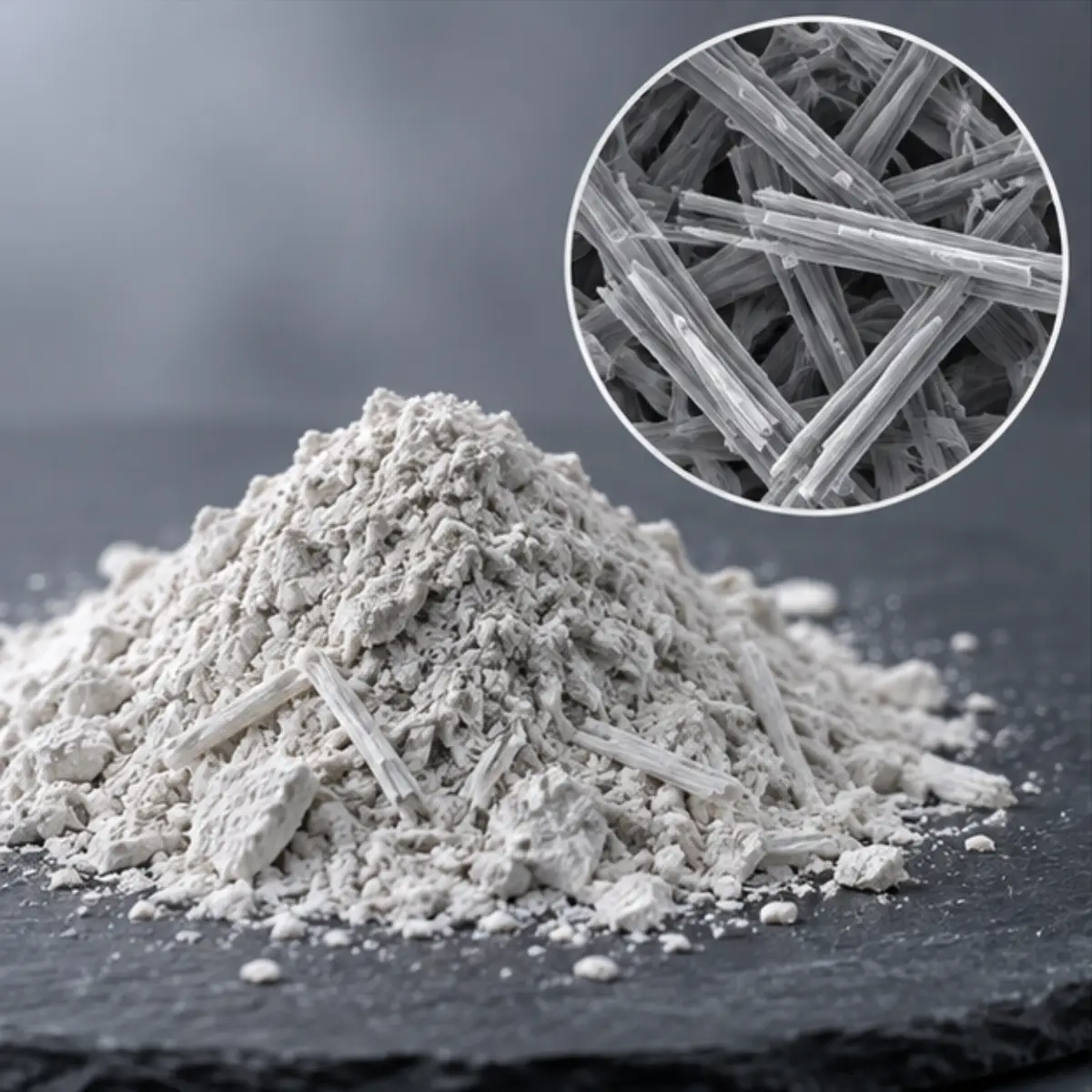
Sepiolite nanoclay is a hydrated magnesium silicate with an elongated, fibrous mineral structure. Unlike the stacked platelets associated with montmorillonite, sepiolite particles form a different dispersion network. This distinction matters when selecting a mineral additive for flow control, suspension stability or evaluation in a polymer formulation.
The term nanoclay does not define the supplied powder’s agglomerate size, mineral purity or surface treatment. Those characteristics, together with the dispersion process, influence how a sepiolite grade behaves. The information here describes the material family; it does not assign an unverified commercial specification.
Sepiolite nanoclay usage and rheology
Sepiolite-based additives are used in coatings and other formulated systems to adjust rheology. A properly dispersed grade may help build a structure at rest that supports suspended particles while permitting flow under shear. The balance between low-shear structure, application flow and recovery must be established in the complete formulation.
Select a grade for the actual aqueous or organic medium. Results from a water-based coating should not be transferred directly to a solvent-based resin or a melt-processed polymer. Surface treatment and preparation method can change the appropriate application route.
Performance objectives to evaluate
- Suspension stability: compare settling and redispersibility during representative storage; initial viscosity alone is insufficient.
- Sag resistance and flow: assess the balance between structure at rest and application behaviour, including levelling where relevant.
- Shear response: measure viscosity across useful shear conditions and recovery after processing or application.
- Polymer formulation fit: where considering sepiolite as a mineral filler, assess dispersion, mechanical response and processing behaviour against a control rather than assuming reinforcement.
Dispersion and formulation development
Establish addition order, wetting time and mixing conditions appropriate to the supplied grade. Insufficient dispersion can leave agglomerates and inconsistent flow behaviour. Excessive reliance on a single viscosity reading can conceal differences in stability or recovery. Record mixing history, solids content and measurement conditions so trials can be repeated.
Run a concentration series with the intended pigments, fillers, binders and other rheology additives present. Check appearance, stability and application performance together. For polymer trials, determine the moisture and processing requirements from the resin and additive documentation. No universal dosage, drying cycle or temperature limit is specified.
Grade selection depends on the polymer system or formulation medium, processing method and end-use requirements.
Related nanomaterials
For comparison with a layered mineral additive, review MMT montmorillonite nanoclay. Sepiolite and montmorillonite have different structures; selection should follow the formulation medium, dispersion process and required flow behaviour rather than a direct substitution assumption.
Handling, packaging and technical enquiry
Packaging options depend on grade and supply configuration. Contact us for details.
Consult the grade-specific SDS for mineral composition, impurities, dust controls and storage instructions. Do not infer a purity level or exposure classification from the sepiolite name. Keep containers protected from contamination; confirm shelf life for the selected grade.
Contact Arawan about sepiolite nanoclay with the formulation medium, mixing equipment and rheology or composite-performance target. Contact us for the appropriate grade and latest technical documentation.
Material-family reference: Tolsa coatings and rheological additives. This reference is not evidence of an Arawan grade’s composition or performance.
Additional information
| Material family | Hydrated magnesium silicate |
|---|---|
| Structure | Fibrous mineral structure |