MMT Nanoclay
Montmorillonite nanoclay for evaluating dispersion, rheology and barrier performance in compatible polymer and water-based formulations.
- Technical Support Available
- Samples available subject to grade and availability.
Technical enquiry
Need help selecting a grade for your polymer? Tell us your resin, processing method and required property improvement.
Description
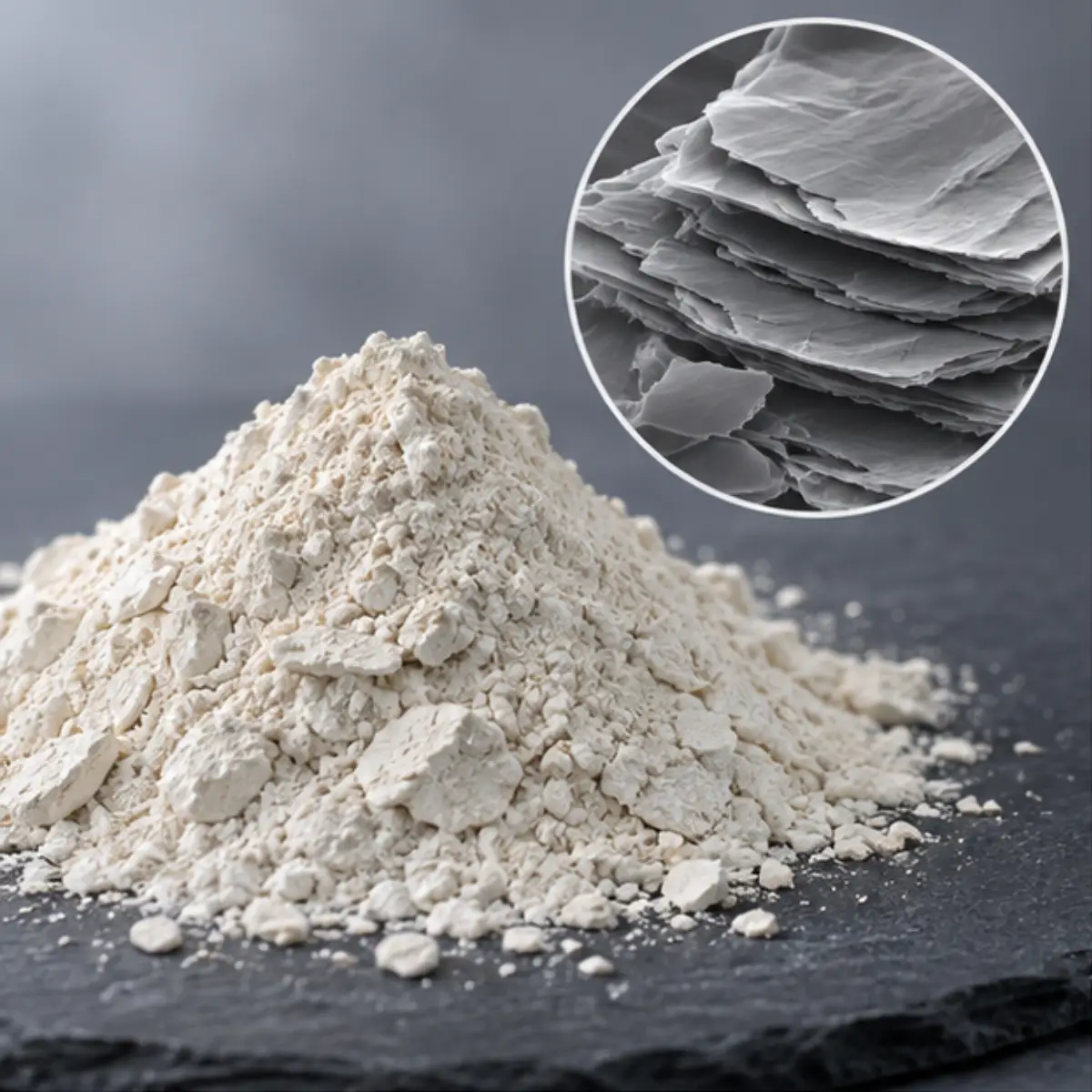
MMT nanoclay is a montmorillonite-based layered silicate evaluated as a functional mineral additive in polymer composites and water-based formulations. Its stacked silicate layers distinguish it from conventional particulate fillers. The useful structure in a finished formulation depends on how effectively those stacks disperse, how the clay interacts with the surrounding material and how the compound is processed.
This page covers the material family rather than a verified commercial grade. Exchangeable cations, mineral purity, moisture and particle-size distribution must be established for the grade under consideration. MMT should not be assumed to be sodium-exchanged, fully exfoliated or suitable for every resin simply because it is described as nanoclay.
MMT nanoclay usage and formulation fit
Unmodified montmorillonite is generally hydrophilic. It is a candidate for aqueous dispersions and compatible polar systems where wetting and dispersion can be controlled. Direct incorporation into a nonpolar polymer can leave clay agglomerates; selecting an organomodified clay or an appropriate compatibility strategy may be necessary. The polymer chemistry and processing route should determine material selection.
Potential advantages to evaluate
- Rheology control: assess changes in viscosity, suspension behaviour and recovery after shear in the complete formulation.
- Barrier behaviour: dispersed, suitably oriented platelets can lengthen diffusion pathways. Measure the relevant gas or vapour transmission rather than assuming a universal barrier improvement.
- Mechanical response: evaluate stiffness alongside elongation and impact behaviour; improved stiffness does not establish improved toughness.
- Dispersion development: compare mixing sequences and conditions using both process observations and appropriate structural analysis.
Processing and qualification
For aqueous systems, establish wetting, hydration time, mixing energy and addition order by trial. Water chemistry and other formulation ingredients can change dispersion and rheology. In polymer processing, check moisture requirements against the resin and grade documentation. A visually uniform blend is not proof that individual silicate layers have separated.
Build a loading series against an unfilled control and record processability, appearance and the actual end-use property. Where layer separation matters, complementary microscopy and X-ray diffraction can help distinguish retained stacks, intercalation and exfoliation. No universal addition rate or processing temperature is specified here.
Grade selection depends on the polymer system or formulation medium, processing method and end-use requirements.
Related nanomaterials
Compare organomodified montmorillonite (OMMT) when assessing clay compatibility with an organic resin. For a different mineral structure in rheology development, review sepiolite nanoclay. These materials require separate grade and formulation trials.
Handling, packaging and technical enquiry
Packaging options depend on grade and supply configuration. Contact us for details.
Follow the grade-specific safety data sheet for powder handling, exposure controls and storage. Keep material protected from contamination and unintended moisture changes. Drying conditions and shelf life require grade-specific confirmation.
Contact Arawan about MMT nanoclay with the resin or liquid system, processing method and target property. Contact us for the appropriate grade and latest technical documentation.
Additional information
| Material family | Montmorillonite layered silicate |
|---|---|
| Structure | Platelet-forming clay |