Organomodified Montmorillonite Nanoclay (OMMT)
Organomodified montmorillonite for polymer nanocomposite development where clay-resin compatibility, dispersion and processing stability must be matched.
- Technical Support Available
- Samples available subject to grade and availability.
Technical enquiry
Need help selecting a grade for your polymer? Tell us your resin, processing method and required property improvement.
Description
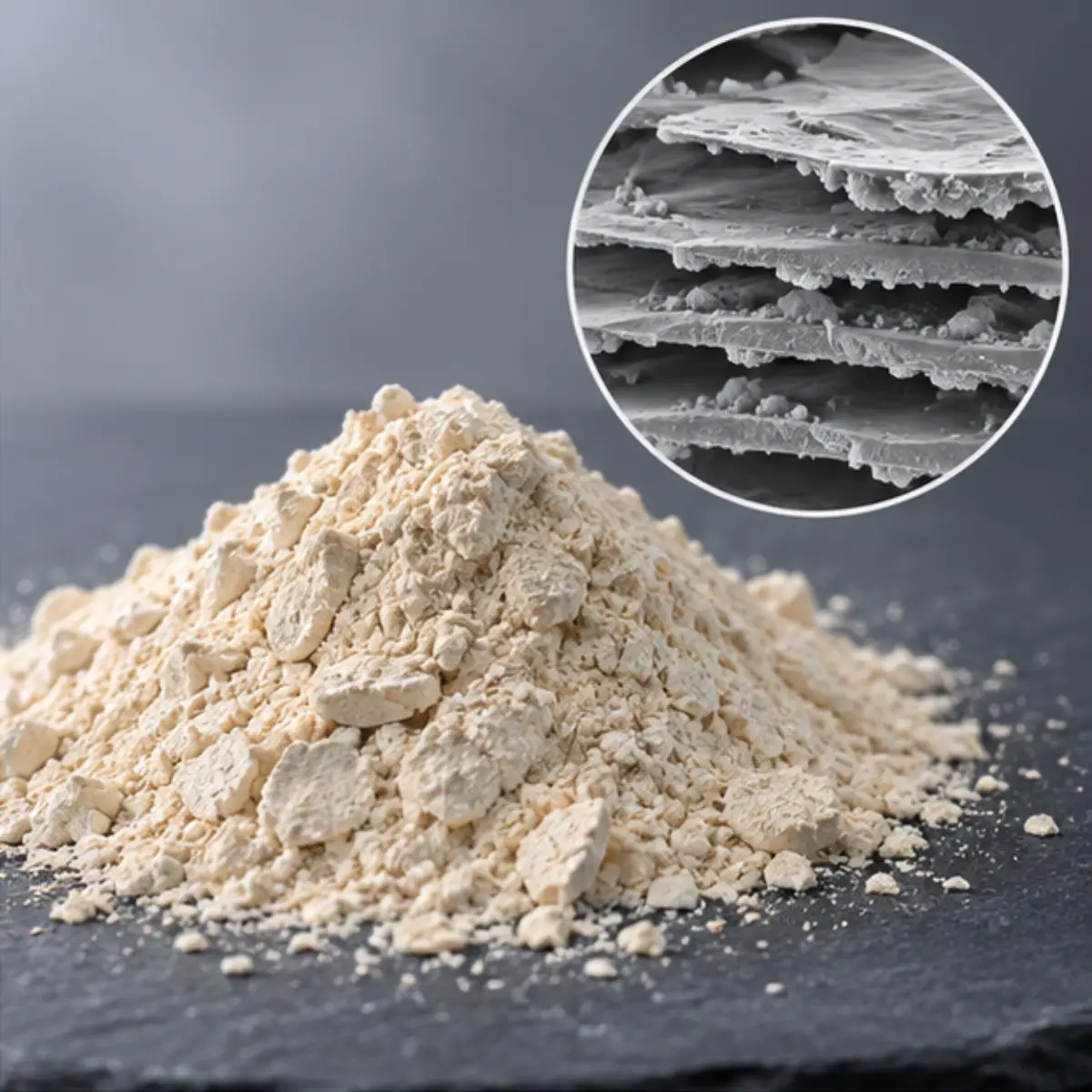
Organomodified montmorillonite nanoclay (OMMT) is a layered clay treated with organic modifiers to change its affinity for organic media. It is considered in polymer nanocomposite development when unmodified montmorillonite does not wet or disperse adequately in the chosen resin. Modification can facilitate polymer access between clay layers, but does not guarantee exfoliation or a particular finished-part property.
Modifier chemistry is a central selection variable. Different organic treatments can behave differently in the same polymer, and one OMMT grade should not be substituted for another solely on the basis of the material name. The modifier identity, treatment level and thermal behaviour of the proposed grade need confirmation.
OMMT usage in polymer formulations
Evaluate organomodified nanoclay in compatible thermoplastic compounds or resin formulations using a processing route appropriate to that grade. Melt compounding and liquid-resin dispersion impose different demands on wetting, shear and temperature exposure. For relatively nonpolar matrices, compatibility measures may still be required even with an organic surface treatment.
Potential advantages and trade-offs
- Compatibility adjustment: organic modification changes the clay surface interaction with the formulation; verify the match experimentally.
- Barrier-property development: dispersed platelets can influence diffusion pathways. Test the actual permeant, humidity and sample thickness.
- Mechanical-property tuning: compare modulus, strength and toughness together rather than treating one measurement as a complete performance assessment.
- Rheological response: monitor viscosity and flow alongside dispersion, because a useful laboratory structure may complicate production processing.
Dispersion and thermal qualification
Define the resin grade, compounding sequence, residence time and temperature profile before selecting the clay. Organic treatment can impose a processing limitation distinct from the mineral itself. Do not set processing limits from the general thermal stability of montmorillonite; obtain data for the treated grade.
Use controlled trials to separate the effects of the clay, any compatibilizer and the mixing process. Check for agglomerates, colour changes, odour and changes in cure or melt behaviour where applicable. Structural analysis can support dispersion assessment, but end-use testing remains necessary. A claimed nanoscale primary structure is not evidence of nanoscale dispersion in a finished compound.
Grade selection depends on the polymer system or formulation medium, processing method and end-use requirements.
Related nanomaterials
Review MMT montmorillonite nanoclay to compare the unmodified clay family. If the project instead targets conductive functionality, explore graphene nanoplatelets (GNP) as a separate filler family requiring its own formulation and testing programme.
Handling, packaging and technical enquiry
Packaging options depend on grade and supply configuration. Contact us for details.
Use the grade-specific SDS to establish storage and powder-handling practices. Confirm moisture limits, drying guidance and shelf life instead of transferring those values from another clay grade. No numerical specification, recommended loading or certification is assigned here.
Discuss an OMMT formulation with Arawan and provide the polymer, processing temperature range, other additives and target property. Contact us for the appropriate grade and latest technical documentation, including modifier information relevant to a production trial.
Additional information
| Material family | Organomodified montmorillonite |
|---|---|
| Structure | Surface-modified layered clay |