Graphene Nanoplatelets (GNP)
Graphene nanoplatelets for evaluating conductive and mechanical functionality in polymer composites, coatings and resin formulations.
- Technical Support Available
- Samples available subject to grade and availability.
Technical enquiry
Tell us your resin or coating system, processing method and required electrical, thermal or mechanical property improvement.
Description
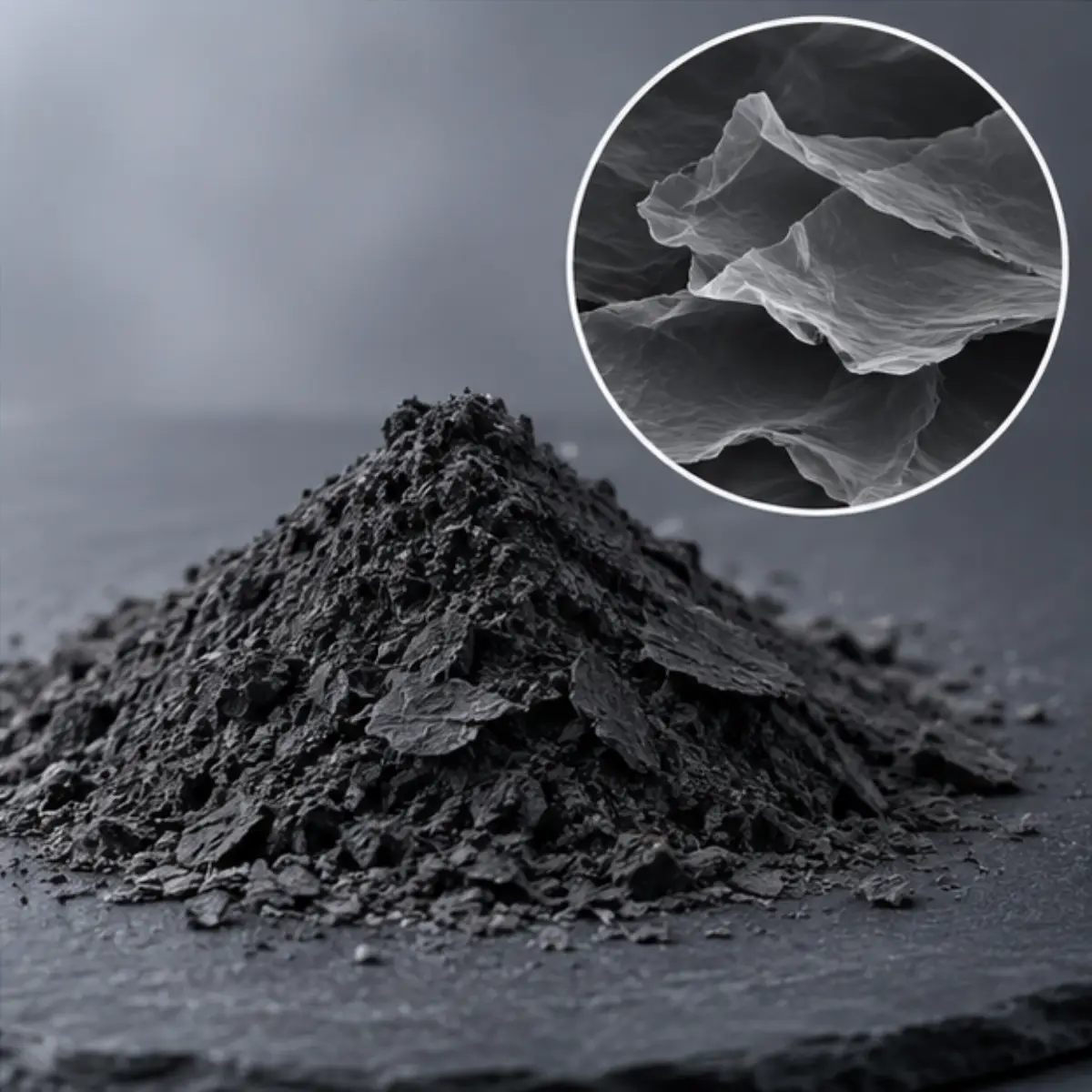
Graphene nanoplatelets (GNP) are platelet-shaped graphitic carbon particles consisting of multiple stacked graphene layers. They are evaluated as functional fillers in polymer composites, coatings and resin systems where electrical, thermal or mechanical behaviour is a development objective. GNP should not be equated with single-layer graphene or assumed to share its idealised properties.
Platelet thickness, lateral dimensions, surface chemistry and agglomeration influence processing and finished-material behaviour. The product name does not establish any of those values. Selection requires a defined grade and a trial programme matched to the matrix, manufacturing process and intended service conditions.
Graphene nanoplatelets usage in formulations
GNP can be considered for conductive composite and coating development, but the filler must disperse and establish useful contact within the formulation. A conductive raw material does not automatically produce a conductive polymer at every loading. Resin chemistry, other fillers and processing history can change the resulting network.
Electrical and thermal targets need separate qualification. A formulation that achieves a desired electrical resistance does not necessarily meet a heat-transfer target. Moulding or coating flow may also orient platelets, making properties dependent on the measurement direction.
Potential functionality and trade-offs
- Electrical response: measure surface or volume resistance as appropriate to the application and examine how it changes with loading and conditioning.
- Thermal transport: evaluate the finished composite’s conductivity in the relevant direction and geometry rather than quoting a raw-filler value.
- Mechanical behaviour: compare stiffness and strength with toughness, elongation and defect sensitivity; agglomeration may compromise performance.
- Processing effects: assess viscosity, flow, surface finish and colour alongside functional results. GNP can affect colour and optical transmission; assess these properties at the intended loading rather than assuming transparency.
Dispersion and qualification strategy
Choose a mixing route appropriate to the resin and supplied form. Effective wetting and agglomerate control are essential; increasing mixing intensity without checking its effects is not a complete dispersion strategy. Keep mixing sequence, temperature and residence time consistent across trials.
Compare a loading series with an unfilled control and document the measurement method, specimen preparation and conditioning. For a conductive application, establish the acceptable resistance range and its repeatability instead of relying on the presence of graphene in the formulation. Confirm cure behaviour or melt processability as relevant before scaling up.
Grade selection depends on the polymer system or formulation medium, processing method and end-use requirements.
Related nanomaterials
If your project also evaluates mineral-based fillers, review organomodified montmorillonite nanoclay (OMMT) for its clay-resin compatibility considerations. OMMT and GNP serve different formulation objectives and should not be treated as interchangeable grades.
Handling, packaging and technical enquiry
Packaging options depend on grade and supply configuration. Contact us for details.
Follow the grade-specific SDS for powder handling, exposure controls and storage. Consider housekeeping and containment appropriate to a fine carbon powder. Confirm the supplied form, carbon content, dimensional characterisation, moisture and shelf life with the supplier; no numerical values are claimed here.
Discuss graphene nanoplatelets with Arawan and provide the matrix, processing route, electrical or thermal target and required test method. Contact us for the appropriate grade and latest technical documentation before approval for use.
Material-family reference: Nanografi graphene nanoplatelet overview. Other suppliers’ grade data are not specifications or performance guarantees for this product.
Additional information
| Material family | Graphitic carbon |
|---|---|
| Structure | Multilayer platelets |